
When to Drain Your Pool: Arizona Water & Calcium Guide
Learn how to tell when your pool water needs an adjustment, when it needs dilution, and why draining an Arizona pool safely involves more than simply opening a hose.
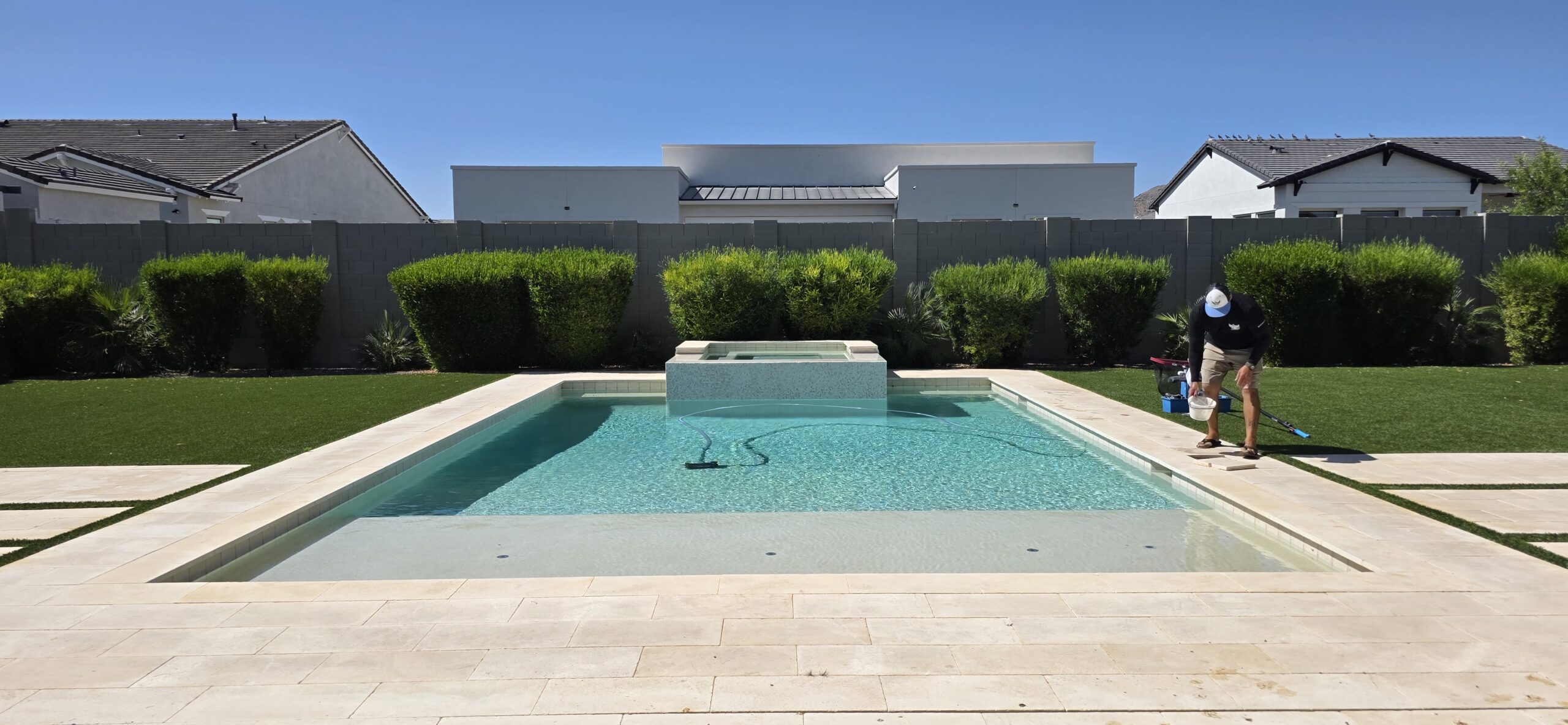
The summer swim season is over, the water finally looks calm again, and you notice a chalky white line on the tile, slightly dull water, and chlorine that refuses to hold the way it did in spring.
That combination is often not a chemistry mistake. After a Valley summer of evaporation, tablet chlorine, and hard fill water, the water itself can become the problem.
When dissolved material has accumulated far enough, the practical fix is dilution: replacing some or all of the pool water with fresh water, then balancing that new water correctly.
The goal is not to drain on a schedule just because the calendar says so. The decision should come from the water test, the surface condition, and the condition of the pool as a whole.
What Total Dissolved Solids Actually Are
Total dissolved solids, or TDS, is a measurement of the material dissolved in pool water: salt, calcium, minerals from fill water, chemical byproducts, sunscreen, dust, algaecide residue, clarifiers, and other dissolved material.
Arizona evaporation drives this number upward because only water leaves the pool. The dissolved material stays behind. Then the pool is refilled with municipal water that already contains minerals, and the cycle begins again.
Evaporation removes water, not minerals. Every refill adds a new mineral load on top of what was already there.
The Signs Your Pool Water Is Worn Out
Waterline Scale
A rough white or gray crust develops on tile, plaster, pebble, or grout and returns soon after cleaning.
Dull or Slightly Cloudy Water
The water is not obviously dirty or green, but it never looks as sharp and clear as it did earlier in the season.
Chlorine That Does Not Seem to Work
The test result appears acceptable, but sanitation performance does not match the reading.
Rising Chemical Use
You are adding more product to accomplish what smaller doses used to do.
Eye or Skin Irritation
Swimmers complain even though the basic pH reading appears normal.
Staining and Rough Patches
Mineral deposits cling to plaster, pebble, grout, and tile instead of brushing away cleanly.
One symptom by itself deserves investigation. Several of these appearing together are a strong reason to run a complete water test before adding more chemicals.
The Readings That Decide Whether Dilution Makes Sense
A proper assessment looks beyond chlorine and pH. The important long-term readings are the ones that tend to accumulate rather than simply being adjusted with another product.
Total dissolved material left behind by evaporation, fill water, and years of chemical additions.
High calcium contributes to scale and rough mineral deposits throughout the pool.
Stabilizer accumulates when stabilized chlorine tablets are used repeatedly.
Salt systems and other dissolved minerals add to the overall concentration of material in the water.
Why Chlorine Can Stop Acting Like Chlorine
Cyanuric acid is useful because it protects chlorine from Arizona sunlight. The problem comes from repeated use of stabilized tablets: the chlorine is consumed, but the stabilizer remains in the water.
Over a long summer, stabilizer can climb high enough that chlorine becomes increasingly slow to act. Homeowners often describe this as “chlorine lock.” The practical correction is dilution with fresh water.
Not Every Pool Needs to Be Emptied Completely
A Partial Drain May Be Enough When
- One reading is high but the others are only moderately elevated.
- You want proportional reduction in TDS, calcium, cyanuric acid, or salt.
- You want to keep the shell loaded with water while improving chemistry.
- The interior surface itself does not need major treatment.
A Full Drain and Refill Makes More Sense When
- Several dissolved readings are far out of range at the same time.
- The pool has gone years without dilution.
- Staining or scale exists below the waterline.
- You need access to inspect tile, grout, drains, lights, or lower surface areas.
Why Draining a Pool Is Not a Garden-Hose Job
An empty shell is exposed to conditions it normally never sees: upward pressure from saturated soil, direct Arizona sun, and the need to route thousands of gallons of water legally and safely.
- Hydrostatic pressure can damage or lift an empty shell under the wrong conditions.
- Plaster and pebble can dry too aggressively when exposed to direct summer sun.
- Drain-water discharge requirements vary by city and should be confirmed before water moves.
- Refilling promptly is part of protecting the interior surface and reloading the shell.
What Can Go Wrong During an Improper Drain
Hydrostatic Pressure
The water inside the pool helps hold the shell down. After saturated soil or heavy monsoon rain, upward pressure can become a real concern.
Surface Exposure
An empty plaster or pebble surface can dry rapidly in Arizona heat. Drain, service, and refill timing matters.
Discharge Route
Chlorinated or saline water can damage landscaping or enter places it should not. Local discharge rules should be checked before starting.
Why Fall Is Usually the Better Time to Drain in the East Valley
Lower Surface Risk
Cooler air and lower sun angle reduce stress on an exposed interior surface.
Post-Monsoon Conditions
Late-season drainage can avoid the worst period of saturated soil associated with active storm cycles.
Easier Start-Up
Fresh water can be balanced without fighting the same extreme evaporation seen during peak summer.
Cleaner Spring Start
You begin the next swim season with fresher water and lower accumulated stabilizer and calcium.
What a Proper Drain and Refill Includes
Pre-Drain Testing
Confirm that dilution is actually warranted and inspect tile, grout, surface, and equipment before water is removed.
Hydrostatic and Site Check
Evaluate groundwater risk, relief-valve conditions, and the planned discharge route.
Controlled Draining
Remove water at a managed pace while monitoring the property and pool shell.
Surface Treatment Decision
Choose the least aggressive treatment appropriate for the plaster, pebble, stains, and scale present.
Tile and Calcium Work
Use the empty-waterline window to address mineral deposits while the surface is exposed and accessible.
Refill and Start-Up
Refill promptly and rebalance pH, alkalinity, calcium, stabilizer, and sanitizer over the following days.
Fresh fill water is not automatically balanced water. Start-up chemistry is part of the drain-and-refill process, not an optional afterthought.
How to Go Longer Between Drains
Manage Stabilizer Sources
Do not rely on stabilized tablets for every chlorine addition all summer long.
Track More Than pH and Chlorine
Watch TDS, calcium hardness, and cyanuric acid trends before they become a late-season surprise.
Keep the Filter Truly Clean
A dirty filter leads to heavier chemical correction and more dissolved product accumulating in the water.
Address Scale Early
Waterline calcium is easier to manage as routine maintenance than as a restoration project.
Use Consistent Weekly Service
Stable chemistry reduces the cycle of shock, correction, and repeated product additions.
Watch Top-Off Volume
Every gallon added to replace evaporation or splash-out brings new minerals with it.
Pelican Pools can incorporate water testing, circulation checks, chemical balancing, and ongoing maintenance into professional pool service throughout Gilbert and the East Valley.
Pool Water Testing, Drain and Refill, and Ongoing Maintenance
Pelican Pools is a family-owned pool service and repair company with more than 40 years of combined experience caring for Arizona pools.
Services include water testing and assessment, drain and refill support, calcium and tile treatment, weekly maintenance, green-to-clean recovery, and equipment repair. Explore Pelican Pools services or request a free estimate.
Pool Drain and Refill FAQs
How often should an Arizona pool be drained?
Many Valley pools fall somewhere around a three-to-five-year drain-and-refill cycle, but the correct decision should come from actual water-test results, how the pool is sanitized, evaporation, fill-water hardness, and surface condition rather than the calendar alone.
Can I drain my own pool?
It is possible, but Arizona conditions add real risk: hydrostatic pressure, direct sun exposure, city discharge rules, and the need to refill and rebalance quickly. A professional evaluation is the safer choice when you are unsure about any of those conditions.
Will draining damage my plaster?
It can if the shell is left empty and exposed too long, or if an overly aggressive surface treatment is used. Proper timing, correct treatment, prompt refilling, and balanced start-up chemistry reduce that risk.
Why does chlorine stop working even when it tests in range?
High cyanuric acid is a common reason in pools that rely heavily on stabilized tablets. The chlorine may still be present, but excessive stabilizer can make it slower and less effective. Dilution with fresh water is the practical correction.
How long does a drain and refill take?
Water removal and surface work can often be handled within a day, while refilling may take part of a day or overnight depending on pool size and water pressure. Start-up balancing then continues over the following days.
Not Sure Whether Your Pool Needs a Drain or Just an Adjustment?
If the waterline is crusting over, chlorine is not holding, and chemical use keeps climbing, the fastest way to stop guessing is to test the full water panel and inspect the pool condition.
