
Green to Clean: How to Recover Your Tempe Pool After a Monsoon Algae Bloom
Monsoon dust, rain, debris, and 105°F water can turn a clear pool green overnight. Here is what happened, what to do next, and how Pelican Pools gets Tempe pools back to blue.
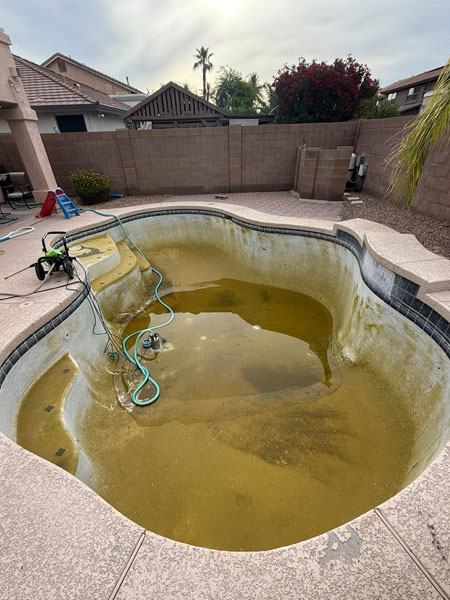
Your Tempe Pool Turned Green After a Monsoon. Now What?
You walked outside this morning, coffee in hand, and your Tempe pool looked like a swamp. Twenty-four hours ago it was crystal clear. Then the monsoon rolled through with 50 mph winds, dust, palm debris, a half-inch of rain, and now it is a shade of green somewhere between lime Gatorade and a pond.
Take a breath. This is one of the most common calls we get in Tempe from June through September, and almost every green pool can be recovered. This guide walks you through what happened chemically, why store-bought shock usually does not fix it, what the professional green-to-clean process looks like, and how to keep it from happening again three days later.
What Actually Happened During That Monsoon
A single Arizona monsoon does three things to your pool at the same time, and any one of them is enough to trigger an algae bloom. Add 105°F water temperature and 14+ hours of daylight, and you have built the perfect algae incubator.
Organic Load Spike
Wind carries in dust, pollen, palm fronds, mesquite pods, olive debris, and whatever was sitting on your neighbor’s roof. Every bit of it eats chlorine on contact.
Chlorine Wipeout
In a healthy Tempe pool running around 3 ppm free chlorine, a big storm can drop you to 0 ppm in under an hour. Algae only needs a few hours at zero to establish.
Runoff and Phosphates
Rainwater sheeting off decking, planters, and lawns dumps phosphates into the pool. Phosphates are algae food, and the higher they climb, the harder it is for chlorine to keep up.
Monsoon season, not July heat alone, is the real green-pool season in Tempe, Mesa, Chandler, Gilbert, and the East Valley.
The Three Shades of Green and What They Tell You
Before you do anything, look at the pool. Color is the fastest diagnostic tool we have because it usually tells you how far the bloom has progressed and how aggressive the recovery needs to be.
Light Green or Cloudy Teal
You can still see the bottom, or at least the top step. This is early-stage free-floating algae. Recovery is typically 2–4 days with the right chemistry and no filter surprises.
Dark Green or Pea Soup
You cannot see the second step. The bloom has multiplied, chlorine demand is enormous, and your filter is about to earn its keep. Expect 4–7 days and at least one deep filter clean.
Black-Green or Swamp
No visible bottom, surface may look oily, and you might see debris mats. This can mean the bloom has been sitting for a week or longer. Recovery can take 7–14 days and sometimes requires a partial drain.
Why the Shock You Bought at the Hardware Store Rarely Works
Most Tempe homeowners try the same thing first: dump four or five bags of cal-hypo shock in at sunset, cross their fingers, and wake up disappointed. The issue is usually not effort. It is chemistry.
Cyanuric Acid Is Too High
Chlorine’s effectiveness is throttled by CYA. In Tempe pools that have been topped off all summer, CYA often creeps past 80 ppm, which means even a huge shock dose acts like a whisper.
Phosphates Were Never Removed
You can shock a pool with 2,000 ppb of phosphates all day, but the algae still has food available. Phosphate treatment is often what keeps the bloom from returning.
The Filter Is Already Loaded
A cartridge that has not been pulled in six months, or sand that is past its service life, cannot polish out dead algae. The water turns gray, then greens back up.
Circulation Is Wrong
Running the pump 4 hours a day during a bloom is like trying to bail a boat with a coffee cup. Green-to-clean recovery requires extended circulation.
The Professional Green-to-Clean Process, Step by Step
Here is the sequence our Pelican Pools techs follow on a Tempe green-to-clean call. If you are going to attempt it yourself, follow the same order. Skipping steps is the number one reason blooms return.
Full Water Panel
Test free chlorine, combined chlorine, pH, total alkalinity, calcium hardness, CYA, phosphates, and TDS. You cannot dose what you have not measured.
Skim, Brush, and Vacuum to Waste
Get the visible organic matter out before adding chemicals so sanitizer is not wasted on dead leaves and storm debris.
Phosphate Remover
Drop phosphates below 200 ppb. This step often decides whether the bloom stays gone or returns within 72 hours.
Rebalance pH and Alkalinity
Chlorine works best around pH 7.2 in a shock scenario. Adjust before shocking, not after.
Shock to Breakpoint
Dose is calculated from pool volume, current chlorine, and CYA, not guessed. A stabilized Tempe pool may need far more shock than the label suggests.
Clarifier, Flocculant, or Filter Work
Heavy blooms may require flocculant and vacuum-to-waste, while lighter blooms may clear with clarifier and filtration. Filters often need deep cleaning or media replacement.
Filter Reality Check After a Bloom
Your filter type dictates how ugly the cleanup gets. Here is what to expect on the back end of a Tempe green-to-clean recovery.
| Filter Type | What Happens During a Bloom | What It Usually Needs |
|---|---|---|
| Cartridge | Pleats clog with dead algae within hours and pressure spikes fast. | Pull cartridges, hose out, chemical soak overnight, and replace if pleats are collapsed or torn. |
| Sand | Channels form in the sand bed and water bypasses the media. | Aggressive backwash, sand cleaner treatment, or sand replacement if it is over 5 years old. |
| DE | Grids blind off, pressure climbs, and filtration efficiency drops. | Full teardown, grid inspection, fresh DE charge, and replacement of torn grids if needed. |
Timeline: What to Expect on Day 1, Day 3, and Day 7
Day 1: Service Visit
Water is tested, debris is removed, phosphates are dropped, chemistry is rebalanced, shock is dosed, the filter is cleaned or media is addressed, and the pump is set to run continuously. The pool often looks worse before it looks better. Cloudy gray or milky white is normal as algae dies off.
Day 3: Cloudy Transition
Water should be transitioning from gray to a light blue-green haze. Chlorine should be holding. Filter pressure may climb again, which is usually a good sign because the filter is doing its job. Another cartridge rinse or backwash may be needed.
Day 7: Back to Stable Water
Water is clear, chemistry is stable, and we transition you back to a normal weekly service schedule. If the pool is still cloudy at day 7, it usually points to a filter issue that has not been fully resolved, not a chemistry issue.
How to Keep It From Happening Again
A pool that turned green once will turn green again unless a few things change. The good news is that prevention is inexpensive compared to another green-to-clean recovery.
Use a Pre-Monsoon Checklist
In early June, verify CYA is between 30–50 ppm, phosphates are under 200 ppb, and the filter has been cleaned in the last 60 days.
Extend Pump Run Time
Run the pump 10–12 hours during monsoon months and shift some circulation overnight so the pool turns over when storms often hit.
Dose After Major Storms
Keep liquid chlorine on hand and dose within a few hours of a major storm. Do not wait until the next morning if the pool took on heavy debris.
Schedule Weekly Professional Service
Getting on weekly service before monsoon season is the easiest way to prevent repeat blooms. Explore Pelican Pools’ pool services to keep your water balanced and clear.
DIY Attempt vs. Call Pelican Pools
| Symptom | Likely Cause | Recommended Action |
|---|---|---|
| Light green, still see the bottom, chlorine holds after dosing | Early bloom with decent chemistry baseline | DIY attempt reasonable: brush, shock, and run pump 24/7 for 48 hours. |
| Dark green, cannot see step 2, chlorine drops to 0 within hours | High phosphates and/or high CYA lock | Call for professional green-to-clean service. |
| Cloudy after shocking, water turns green again in 2–3 days | Filter failing or phosphates untreated | Professional filter service plus phosphate remediation. |
| Black spots on plaster or grout that brush won’t remove | Black algae anchored in surface | Professional treatment, sometimes requiring partial drain and acid wash. |
| Green pool plus visible debris mats, oily surface, or foul smell | Long-standing bloom with likely bacterial load | Do not swim. Professional recovery required, possible drain. |
Arizona Pool Pro FAQ
Is a green pool safe to swim in?
No. Beyond the visibility hazard, algae blooms often coincide with elevated bacteria levels, including pseudomonas and E. coli after runoff. Stay out until chemistry is verified back in range.
How long does green-to-clean take in Tempe?
Most light-to-moderate blooms are swimmable again in 3–5 days. Dark green pools average 5–7 days. Swamp-grade recoveries can run 10–14 days, especially if a drain is needed.
Will I need to drain the pool?
Usually no. Draining is a last resort reserved for pools with CYA over 100 ppm, TDS over 3,500 ppm, or established black algae. Pelican Pools always starts with diagnosis before recommending a drain.
Why did my pool turn green again three days after I shocked it?
Nine times out of ten in Tempe, the answer is phosphates that were never removed or a filter that could not polish out the dead algae. Shock alone is a symptom treatment, not a cure.
Does homeowner’s insurance cover a green pool cleanup?
Standard policies generally do not cover routine maintenance or storm-driven algae blooms. If a covered event like hail, a fallen tree, or a plumbing burst caused the problem, it may be worth calling your carrier.
Get Your Tempe Pool Back to Blue
Pelican Pools has 40+ years of combined experience recovering green pools across Tempe, Gilbert, Mesa, Chandler, and the East Valley. We diagnose before we dose, document our work, and hand you back a pool with a plan to keep it clear.
Request a Free EstimateRelated services: Green Pool Cleanup and Pool Service · Schedule Pool Service in Tempe
The Pelican Pools Team
